Welcome to the Mathematical World!
Nicomachus of Gerasa
Neo-Pythagorean Master of Number Theory and Arithmetic
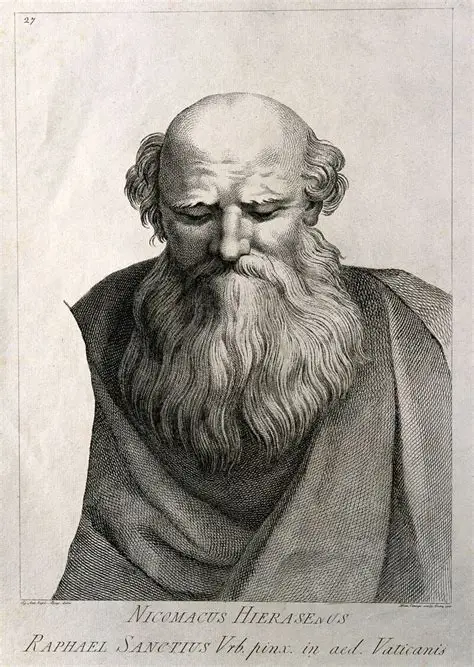
Nicomachus of Gerasa (c. 60–c. 120 CE) was a Greco-Roman mathematician and philosopher whose works preserved and expanded the arithmetical traditions of Pythagoras and Plato. Born in Gerasa (modern Jerash, Jordan), Nicomachus was a leading figure of the Neo-Pythagorean school, which viewed mathematics not merely as a computational tool but as a key to understanding the cosmos and divine order.
His most influential surviving work is Introduction to Arithmetic (Arithmetike eisagoge), which presents a systematic account of number theory in a form accessible to learners of his era. Rather than focusing on practical calculation, Nicomachus emphasized the qualitative properties of numbers, categorizing them into types such as even, odd, prime, composite, perfect, abundant, and deficient. A perfect number, according to him, is one where the sum of its proper divisors equals the number itself. For example, \(6 = 1 + 2 + 3\), and \(28 = 1 + 2 + 4 + 7 + 14\). This fascination with numerical perfection reflected a deeper metaphysical belief: that numbers were the foundation of all reality.
Nicomachus also explored polygonal numbers, figurate numbers, and mathematical harmonics—the numerical ratios underlying musical intervals. In this, he echoed Pythagorean thought, linking the structure of numbers to the harmony of the universe. For instance, he noted that the octave corresponds to the ratio \(2:1\), the fifth to \(3:2\), and the fourth to \(4:3\).
Although his work lacked the rigorous proofs of Euclid’s Elements, it had immense influence during Late Antiquity and the Middle Ages. The Latin translation by Boethius ensured that Nicomachus’s ideas shaped medieval European mathematics, especially in the quadrivium (arithmetic, geometry, music, and astronomy). His emphasis on classification and symbolism appealed to scholars who saw mathematics as a philosophical and mystical discipline.
Nicomachus’s legacy lies in his role as a transmitter of Greek number theory and as a figure who bridged computation, philosophy, and cosmology. While modern mathematics demands more proof-based rigor, his vision of numbers as the key to cosmic harmony continues to inspire historical and philosophical reflections on mathematics.

All rights reserved by the Mathematical Unity
Contact: +8801400044645
Email: mathematicalhorse1453@gmail.com
Our Discord Server: Mathematical Unity [Ulus Riyadiyat]